
Eduskills+
each.eduskills.plus

Hands-On Activities for Young Thinkers

10 Thinking about Waste and Creating Imaginary Environments

Teach children about how images can be manipulated and how easy it is to create fake photos. This activity will help them understand that not all images reflect reality and foster critical observation skills. This increases their sensitivity to environmental issues by making them alert to details that often go unnoticed. For example, social contradictions such as encouraging people to avoid using plastic bags while wrapping in plastic items to sell stuff cheaper and force buyers to buy more quantity.

Erasmus+

Funded by the European Union. Views and opinions expressed are however those of the author(s) only and do not necessarily reflect those of the European Union or the European Education and Culture Executive Agency (EACEA). Neither the European Union nor EACEA can be held responsible for them.

All contents, in particular texts, pictures and graphics, are protected by copyright. Unless expressly stated otherwise, copyright is held by each.eduskills.plus and is licensed under Creative Commons Attribution - Non-commercial - Distribution under the same conditions 4.0 International license. They may be subject to the terms of the license.

© 2026 each.eduskills.plus

10 Thinking about Waste and Creating Imaginary Environments

Digital

Teach children about how images can be manipulated and how easy it is to create fake photos. This activity will help them understand that not all images reflect reality and foster critical observation skills. This increases their sensitivity to environmental issues by making them alert to details that often go unnoticed. For example, social contradictions such as encouraging people to avoid using plastic bags while wrapping in plastic items to sell stuff cheaper and force buyers to buy more quantity.

Making it Inclusive

Make sure you use examples to point out that everyone belongs even if their imagination is different from the majority, and how variation in imagination increases everyone’s ability to imagine. Point out in the history of humanity people who imagined very different things contributed to the development of science, technology, arts and the humanities.

Task 1: Permanent Error

  1. Explain that a photobook is a collection of photographs which tell a story with pictures. Look together at the photo book “Permanent Error” by Pieter Hugo. You can also look at the pictures online.
  2. Ask the children what they think the pictures are showing. Explain to them that this is the story of Agbogbloshie, which was one of the biggest waste dumps in the world. It is home to 80,000 people. Every day, huge amounts of e-waste, mostly TVs and computers, was burned to extract valuable metals. This e-waste came from around the world, but mostly from Europe and the US.

Discussion Plan: How can we deal with waste?

  1. What happens with our garbage?
  2. Can people diminish the garbage they produce?
  3. Do different people make different amounts and types of waste?
  4. Can people completely stop producing garbage?
  5. Can countries diminish the garbage they produce?
  6. Can all garbage be reused somehow?
  7. What is waste?
  8. Can something be a waste for someone and valuable for someone else?
  9. Can we create something valuable with our garbage?
  10. Can people diminish the waste they produce?

Philosophical exercise

  1. Compare and contrast garbage and waste and what to do about it.
  2. Consider if the items can become (or produce) garbage and if they can become (or produce) waste, and what people can do about it.
  3. For each item, think about whether it becomes garbage (everyday household trash), waste (a broader category that includes all types of discarded materials), or both. What can people do to reduce the amount of garbage or waste for each item?
Worksheet: garbage, waste and what people can do about each item.
Item Garbage What can people do? Waste What can people do?
Food
Paper
Toys
Clothes
Phones
Computers
Cars
Supermarkets
Factories

Task 2: Creating a photobook with their thoughts about previous group discussions

  1. Explain to the children that they will create their own photo book. They can plan and think about how their photobook should look-like, and kindergarten teachers write the thoughts the children have expressed and concluded from the previous discussions. Make sure to highlight that when one creates a photobook with sustainability in mind the way the materials to use are selected, and which photos are chosen are different than when sustainability is not a core concern. Use this in all activities you can to raise awareness of how focusing on sustainability makes a difference even when it is not specifically stated.
  2. Choosing and Cutting Out Photos

    Photograph children. They can take different positions but it is best if the picture shows the full body. Print the pictures and provide each child with a printed photo of themselves. Assist the children in carefully cutting out their image using scissors.

  3. Selecting Backgrounds

    Lay out old newspapers and magazines. Let the children choose backgrounds and images and cut them out.

  4. Creating the photobooks

    Children paste the backgrounds and their own pictures and the important sentences from previous discussion on a paper and bind it together as a book, leaving an empty page for parents and family to give feedback.

Task 3: Real or imaginary?

Use the created photobooks to discuss that not all photographs are real. Have they really been in places that are shown? Or have they created an illusion? Discuss how photos can be changed or edited and why it’s important to understand that images might not always show the truth, and that there are ways to confirm information given in images. Refer specifically to environmental issues as to reinforce that concern with sustainability is at the centre of the activity.

Collaborative thinking: have the children look at the photos and chat about the following questions.

  1. Can you tell that these photos are imaginary and not real? How?
  2. Why do you think people might create imaginary photos?
  3. How can we tell if a photo is real or fake in real life?
  4. Do you think that imaginary photos are used in advertisements?
  5. Why do people like to take pictures of themselves on holidays?

Task 4: Appearance and Being

  1. Start by showing them the Müller-Lyer illusion and talk about the appearance of the lines.
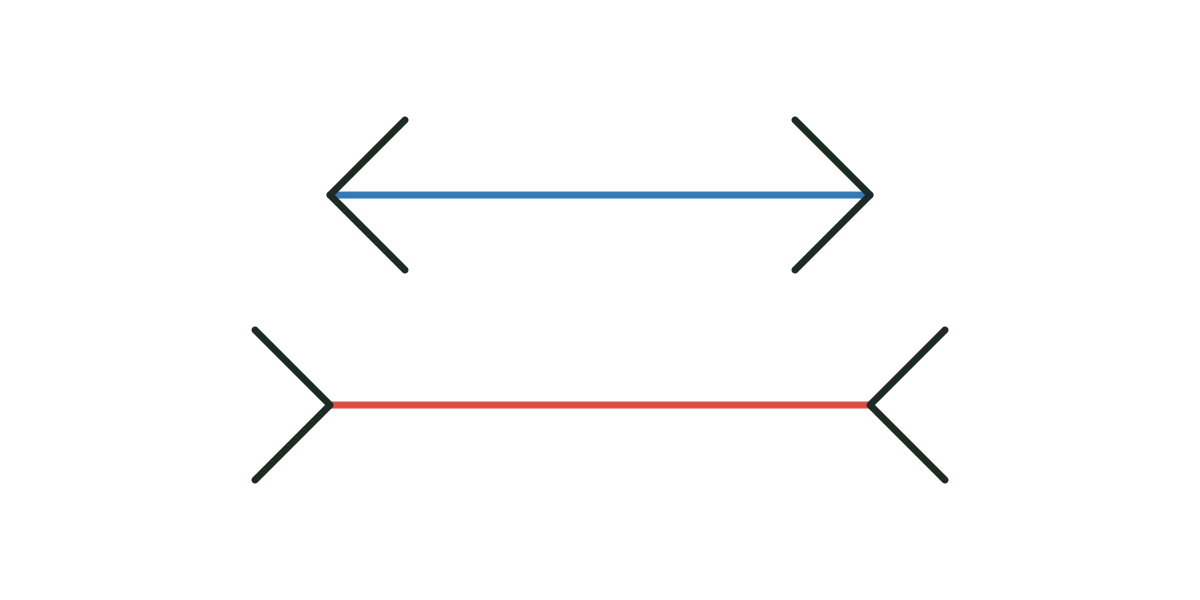
    The Müller-Lyer illusion: two horizontal lines of the same length, one ending in arrowheads that point outwards and one ending in arrowheads that point inwards.
    The Müller-Lyer illusion: the two lines look different in length, but they measure the same.
  2. Ask them how they can make sure the lines are different and how they can be sure of the difference. Once they have found out that the lines measure the same, suggest looking for explanations why that happens.
  3. Once they have reached a conclusion of some kind, show the result of the reflection in an image like this one:
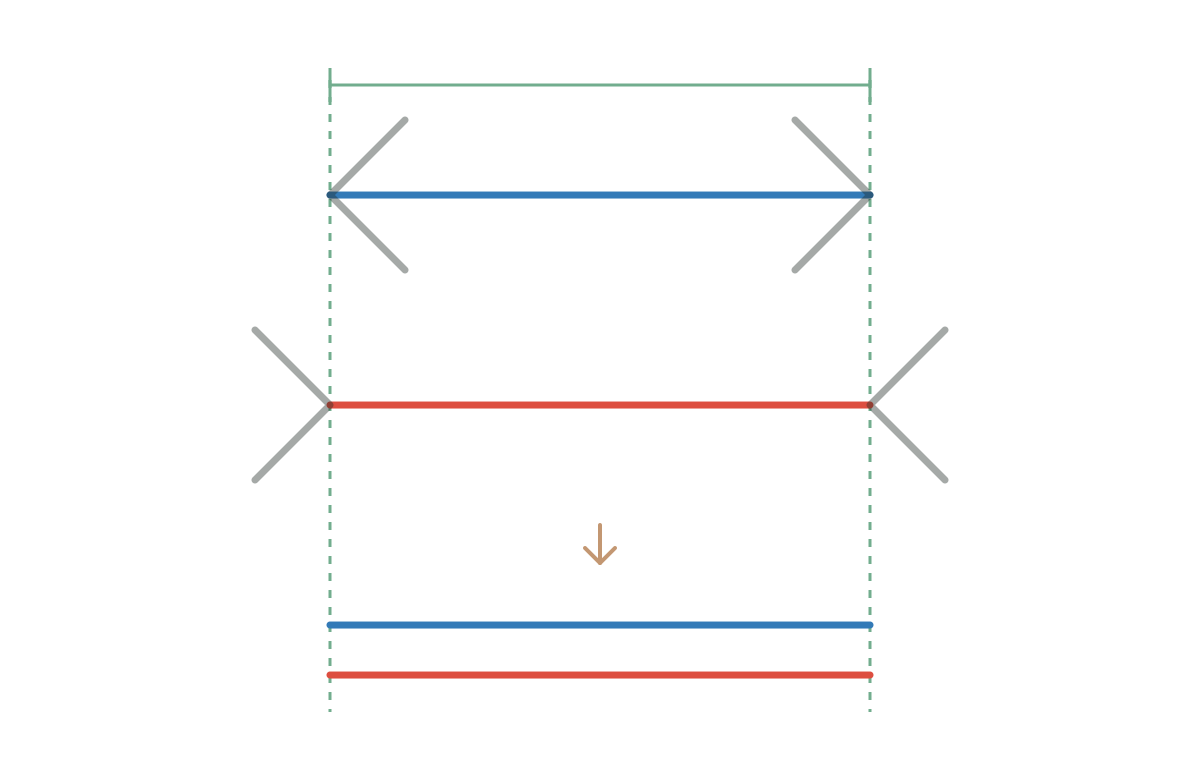
    The same two Müller-Lyer lines placed one above the other with a measuring guide, showing that both lines are exactly the same length whichever way the arrowheads point.
    Measuring the two lines side by side shows that they are the same length, whichever way the arrowheads point.
  4. Then consider other possibilities of things that look like something but are other things and make cards with them. Make sure to include images of nature to be able to ask if it is possible to see, for instance, that the glaciers are disappearing. Have a philosophy session in which they try to work out what something looks like, what something is, and why there is a difference in appearance. Examples to be possibly explored: how things look under a microscope; how a straw in a glass of water can look like it is bent; how people can wear fake moustaches and wigs, how people can wear costumes in plays; make believe in the playground, how animals in the environment pretend to be something else (stick insect); etc.

Discussion Plan

  1. Can something be something and appear something else?
  2. Can the appearance always be convincing?
  3. Can something be a visual illusion?
  4. Is an illusion something false?
  5. Do we still see the illusion even when we know it is one?
  6. Can some things always look like what they are?
  7. Can something be ugly and appear beautiful to other people?
  8. Can a fake moustache be better at looking real than another fake moustache?
  9. Are there things we cannot fake?
  10. Why would some animals disguise their appearance?

Variations

Further Ideas

  • Use the manipulation in a movie picture Have the children place different backgrounds in film format.
  • Make a moving picture with stop motion explaining illusions Use stop motion application to explain their experience to other children.